
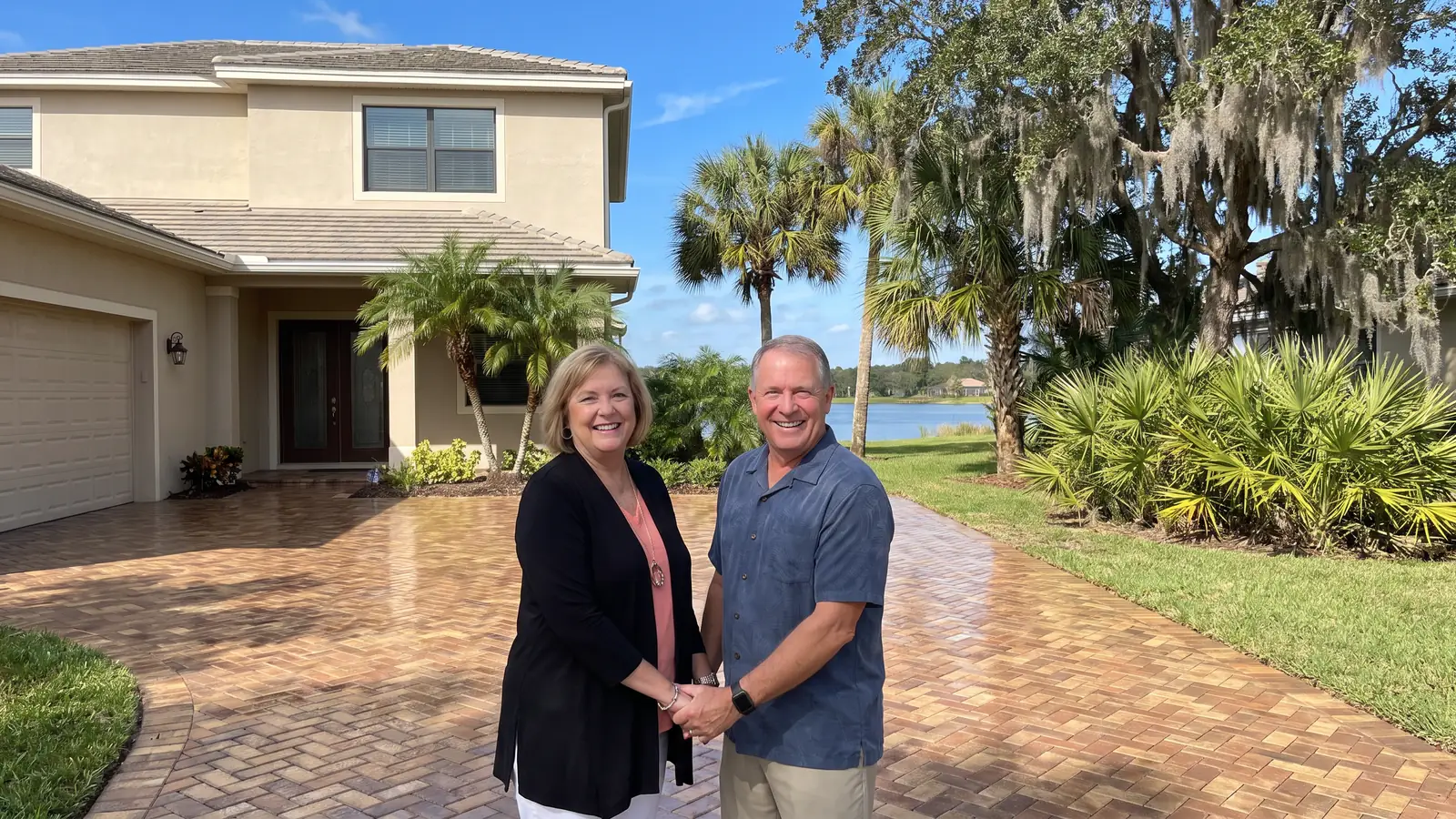
Deeper color, tighter joints and easier upkeep
Paver Sealing in St. Cloud, FL
Call (689) 329-1673 for a free paver sealing estimate on your driveway, pool deck or patio.
- Brings out deeper paver color
- Fresh joint sand helps lock pavers in place
- Gives weeds less room to grow
- Makes the surface easier to keep clean
- Free estimate, no obligation
Request a Free Estimate
Free, no obligation.
Who can seal the pavers at my St. Cloud home?
A local contractor seals pavers throughout St. Cloud, FL, and you will hear back within 1 business day, usually much sooner. The estimate is free, and booking is your call. To begin, call (689) 329-1673.
Sealing deepens the color of the pavers, holds the joint sand where it belongs and makes dirt and algae easier to rinse away. Think of the driveway after a long wet summer, dull along the tire lanes and thin on sand, then dark, even and full again. Tires and oil hit a driveway, splash and bare feet hit a pool deck, and each area gets a plan to match. When you send the free estimate form, say how each one is used.
Paver Sealing St Cloud Is Proud to Serve Central Florida
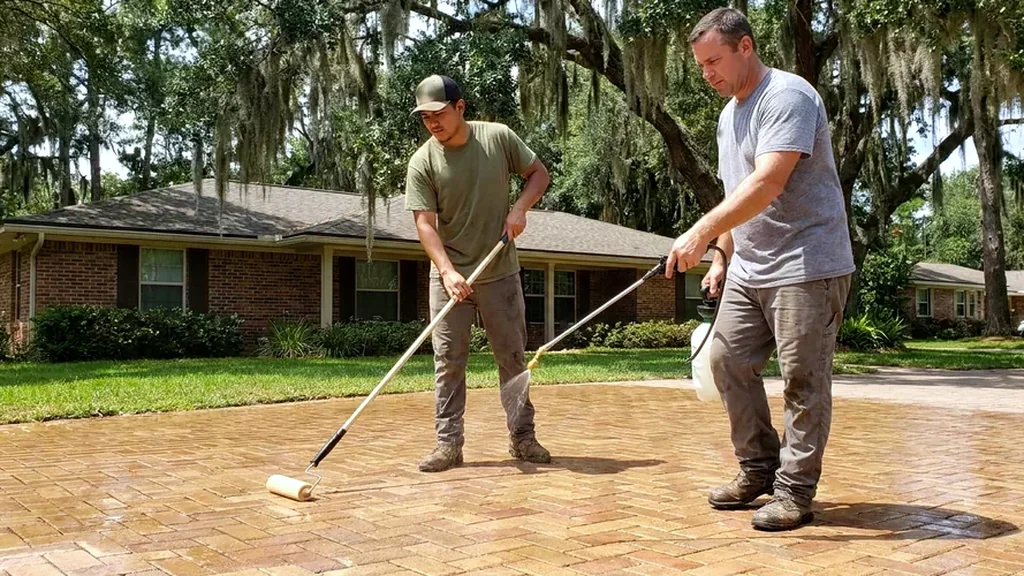
What does a paver sealing job include in St. Cloud?
A sealing visit has four stages: a walk-through, a wash, fresh joint sand and the sealer coat. The wash takes the longest. To go through each stage, call (689) 329-1673.
Walk-through
Square footage, sunken pavers, bare joints, old sealer and any spot where water stands are noted before a price is set.
Wash
An algaecide treatment and a high-volume, low-pressure wash take algae, weeds and grime off the surface.
Joint sand
Sand is swept in and wet down so the pavers lock together and weeds have less room.
Sealer coat
The product goes on dry pavers at the coverage the manufacturer prints on the label.
How do I know my pavers are ready for a new coat?
A Central Florida company that seals pavers lists five signs: color that looks flat or chalky after a rinse, joints that loosen near downspouts, water that darkens the surface instead of beading, white blotches that stay after dry weather, and tire marks that no longer wash off. One sign is enough to call. Resealing while some coat remains also keeps the new layer thin. For a quick opinion, call (689) 329-1673.
Water-based or solvent-based sealer: which suits St. Cloud?
Ask the contractor which product goes down and why. Castle Clean and Seal calls water-based sealer the professional standard for Florida humidity because moisture can escape through the paver, and it says a low quality solvent-based sealer turns white and peels. Kennelly Paver and Restoration uses water-based sealer on brick pavers. To compare options for your surface, call (689) 329-1673.
Unilock gives solvent-based sealer its own strengths, with a higher gloss and a life of four to five years when it is kept up, but it needs perfectly dry pavers and joints. Unilock also says to test the compatibility of a new sealer against the old one before resealing, so ask the contractor to do that. Request the brand name and data sheet when you send the free estimate form.
Wet look, natural or matte: which finish fits my pavers?
Wet look deepens the color and adds sheen, and natural or matte keeps the pavers close to how they looked new. A Central Florida company that seals pavers says penetrating natural finishes breathe more and are less likely to haze if a pop-up storm passes. Unilock warns that high gloss may turn slippery when wet, so a pool deck or a sloped drive leans toward matte. Request a sample of each when you send the free estimate form.
How often do pavers in St. Cloud need resealing?
Plan on every two to five years, and let the surface set the date. A Central Florida company that seals pavers suggests two to three years for a wet look driveway, two to four for a pool deck and three to five for a natural finish patio. Kennelly Paver and Restoration adds a maintenance wash every 12 to 15 months to get the most from a coat. To have yours checked, call (689) 329-1673.
How many coats does a paver job need?
The paver decides, not a sales pitch. Western Interlock says a first flood coat shows how absorbent the paver is: heavy pooling means one coat is enough, and little pooling means a second is needed. Unilock warns that stacking layers on one spot causes uneven gloss. Castle Clean and Seal applies two to three coats, so ask any company why it picked its number before you send the free estimate form.
What weather suits a sealing job in St. Cloud?
Pick a dry window and an early start. A Central Florida company that seals pavers says sealing earlier in the day after dry weather lowers the risk of whitening, and Unilock asks for 24 to 48 hours of clear skies before the work and up to 48 hours after. Western Interlock warns that sealer may not work if the paver surface passes 90 degrees, which full sun can do on a day that feels milder. To line up a day that fits the forecast, call (689) 329-1673.
Pavers can also hold hidden moisture. Western Interlock says the joints and base can stay wet while the top looks dry, which shows up later as cloudy patches. Ask how the contractor checks for it when you send the free estimate form.
Is it too soon to seal newer pavers?
Often, yes. Unilock says efflorescence, the hazy film of natural salts on new concrete pavers, usually takes two to three months to clear and can take up to a year. Sealing over it can trap the haze under the coat. St. Cloud added many homes in the last two decades, so tell the contractor your install month when you call (689) 329-1673.
Which paver surfaces can be sealed?
A driveway, a pool deck, a patio or a walkway can take a sealer coat. Wear differs on each, so the plan should follow how the area is used. To begin with yours, send the free estimate form.
Driveways
A Central Florida company that seals pavers says the tire paths fade first on a driveway, and oil lands where the car sits. Sealing here pays off most along those tire lanes.
Pool decks and lanais
Castle Clean and Seal notes that pool decks face chlorinated water and constant moisture. Sealing around a pool should leave a surface that still grips and still drains.
Patios
Covered or partly shaded patios tend to grow more algae and mold than sunny driveways, Castle Clean and Seal says. Sealing on a patio goes after the green film along the shaded edge.
Walkways and entries
A Cleaner Touch says leaves break down into tannins and fertilizer granules can etch the surface, and both end up along a front walk. Sealing at the entry is a small job, and guests step on it first.
What paver problems are common in St. Cloud?
Five problems come up often: tire lanes that dull first, sprinkler spray, sand washing out at downspouts, green film in damp shade and old sealer that has turned cloudy. Each costs less to handle early. To learn which apply to you, call (689) 329-1673.
1. Tire lanes that dull first
A Central Florida company that seals pavers says Orlando sits in a high-UV zone with long, hot summers, and that on a wet look driveway the tire paths fade first. After that the edges next to the sprinklers go.
2. Sprinklers on a fixed schedule
Toho Water Authority sets watering days by house number, so the same spray can hit the same wall twice a week. UF/IFAS says most Florida well water is high in iron, and homes on a private well can end up with orange streaks.
3. Sand washing out at downspouts
A Central Florida company that seals pavers lists joints that loosen or wash out near downspouts and slope breaks as a sign of wear. Once the sand goes, weeds and shifting pavers follow.
4. Green film in damp shade
Orlando gets over 50 inches of rain a year, an Orlando paver company says, and humid air grows algae and mold on unsealed surfaces. Castle Clean and Seal adds that covered or partly shaded patios tend to grow more algae and mold than sunny driveways.
5. Old sealer that turned cloudy
A sealer that has gone white, cloudy or started to peel has to be chemically stripped before a new coat can bond, according to an Orlando paver company. Stripping is the step that changes a quote the most.
What does paver sealing cost in St. Cloud?
Central Florida paver companies publish $1.50 to $3.00 per square foot to clean, sand and seal, and this site uses that range for St. Cloud. Castle Clean and Seal lists driveways of 600 to 1,200 square feet at $1.50 to $2.50 and says a 400 square foot pool deck can run near $2.50 while a 1,200 square foot driveway lands closer to $1.50. Larger areas can land at the low end of the range because setup time stays the same. For a number written for your home, send the free estimate form.
Stripping a failed coat adds cost. Castle Clean and Seal puts it at $500 to $1,000 or more, and Kennelly Paver and Restoration lists $3.50 to $5.00 per square foot for stripping and resealing, with two to three days of work. Kennelly also says a quote near $10 per square foot usually comes from an installer, not a sealing company. To compare a quote you hold, call (689) 329-1673.
Only need a wash? Read the paver cleaning and joint sand guide, or browse the towns served around St. Cloud.
| Paved area | Typical example | Clean, sand and seal |
|---|---|---|
| 300 sq ft | Small patio or walkway | $450 to $900 |
| 600 sq ft | Two car driveway | $900 to $1,800 |
| 1,000 sq ft | Large driveway or pool deck | $1,500 to $3,000 |
| 1,500 sq ft | Driveway plus pool deck | $2,250 to $4,500 |
Math based on the $1.50 to $3.00 per square foot that Central Florida paver companies published as of November 2026. Your contractor sets the actual price after seeing the surface. Repairs, leveling and stripping failed sealer are usually extra.
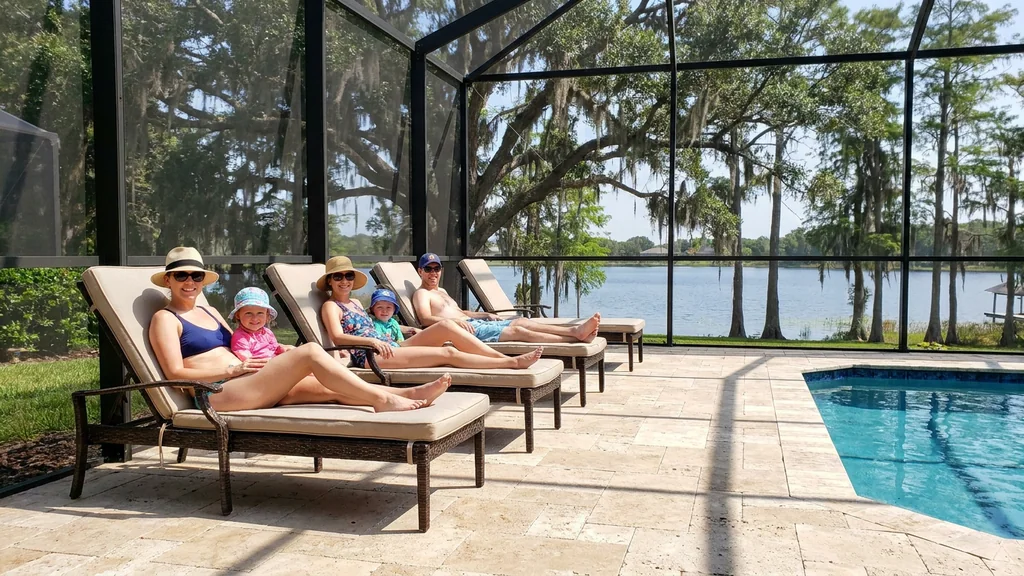
Why hire a local contractor for paver sealing in St. Cloud?
A contractor who works around St. Cloud already plans for afternoon storms, damp shade and sprinkler schedules. You get the price on paper, and the decision stays yours. To begin, call (689) 329-1673.
Contractors who work in Osceola County
A company that covers St. Cloud already plans around the afternoon storms, the summer sun and the watering schedule. That makes the first visit more useful.
Free to ask
There is no charge for the look or the quote. Turn the price down and nothing more happens.
A range you can check
Central Florida paver companies publish $1.50 to $3.00 per square foot to clean, sand and seal, and this site shows the same range. A quote far outside that range is worth asking about.
You decide when
Ask for the price in writing and decide when you are ready. Read the contractor standards page for the points worth confirming first.
Ready for a free paver sealing estimate in St. Cloud?
Phone or fill in the short form, and a contractor writes or calls back within 1 business day, often much sooner.
Free, no obligation
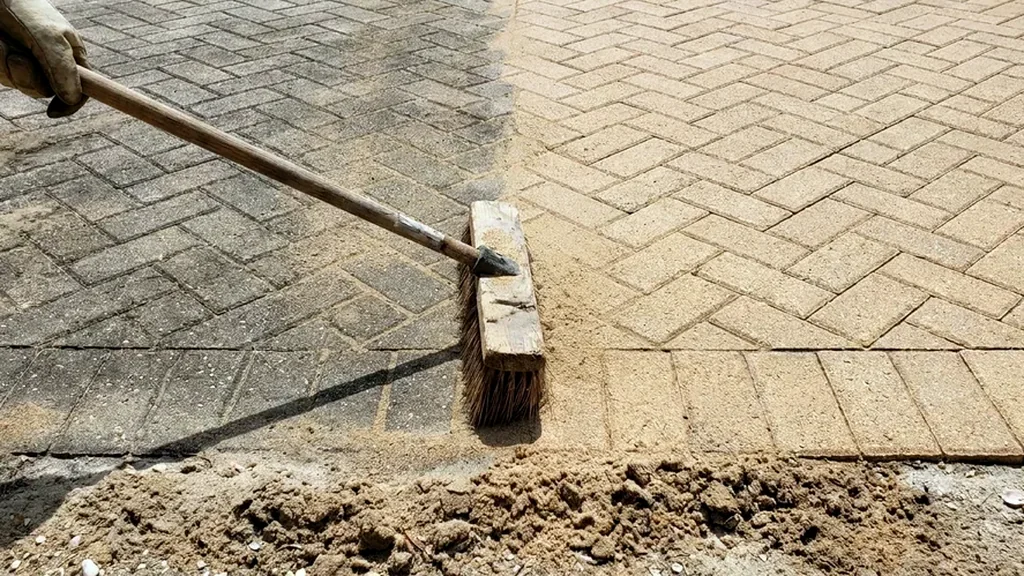
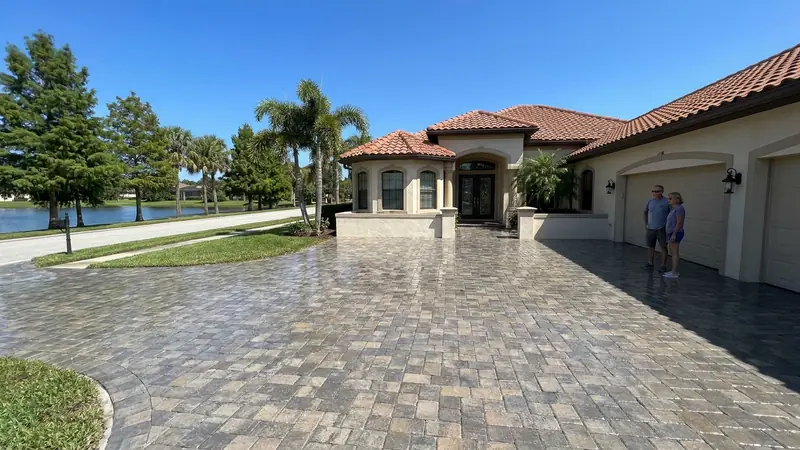
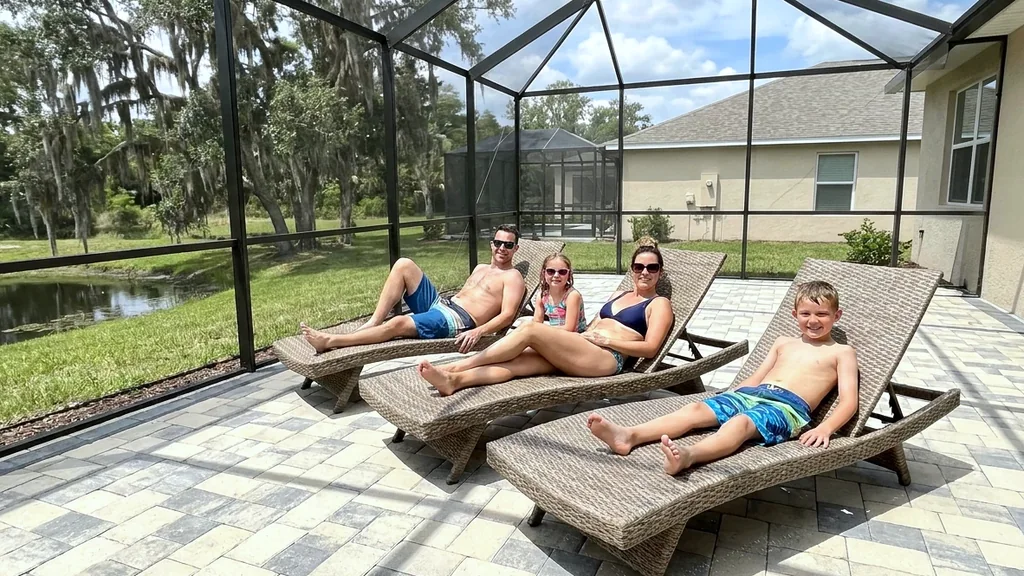
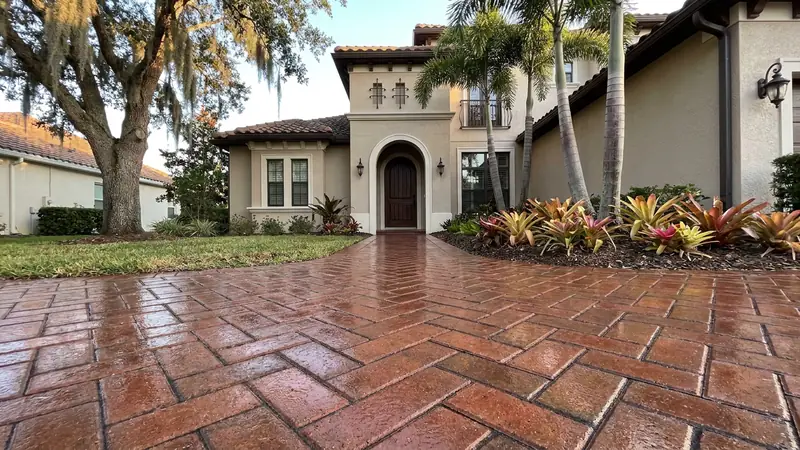
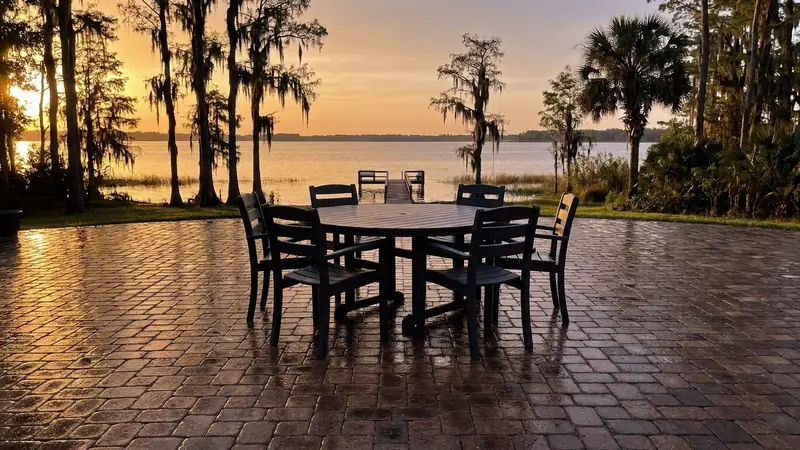
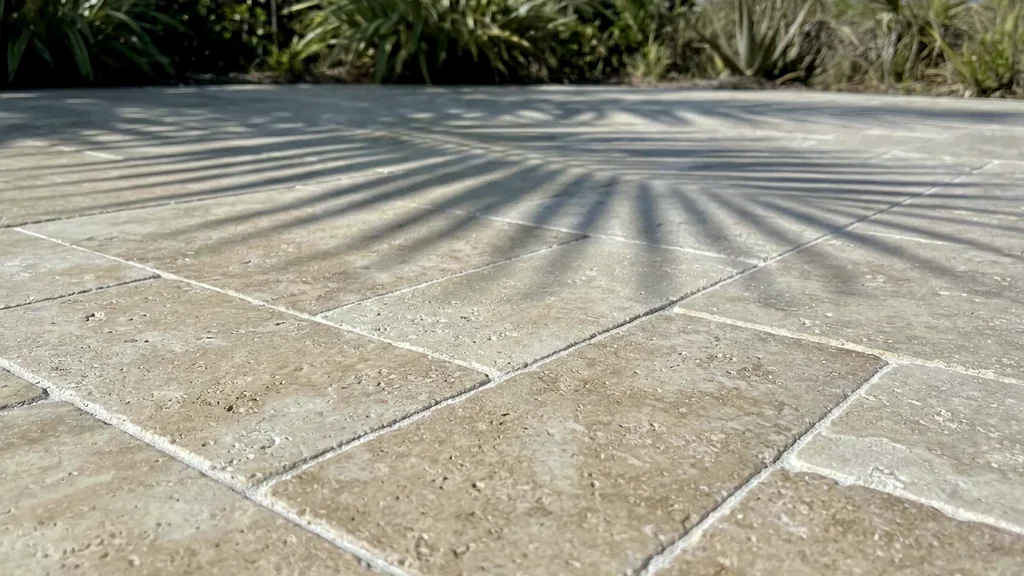
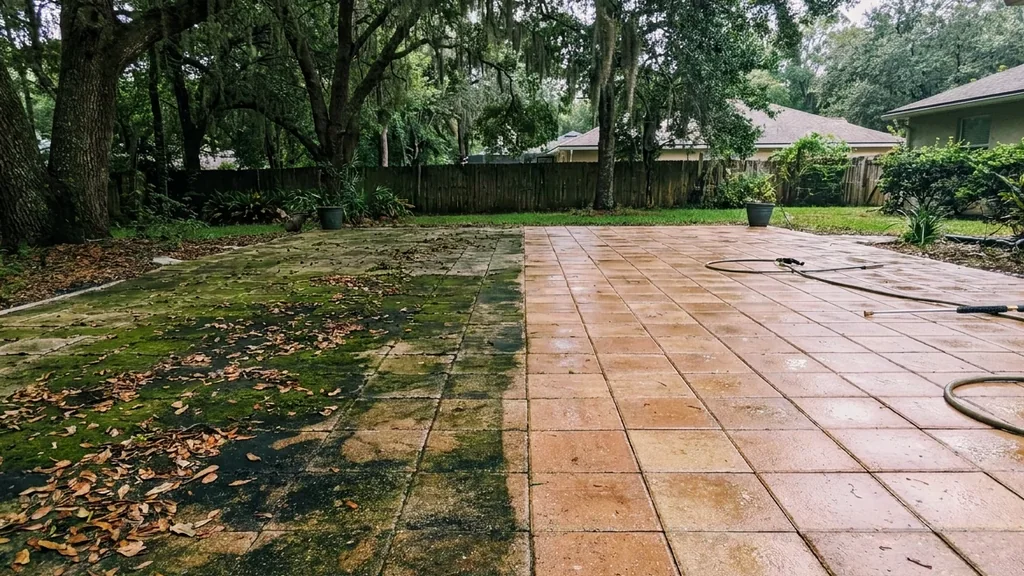
What does a fresh seal look like on pavers around St. Cloud?
How does the paver sealing process work in St. Cloud?
Most jobs follow five steps, from the first measurements to the last walk-through. To get on the schedule, call (689) 329-1673.
1. Measure and ask
The contractor measures the area for the sealing quote, marks sunken pavers and old sealer, and asks which days the sprinklers run.
2. Treat and wash
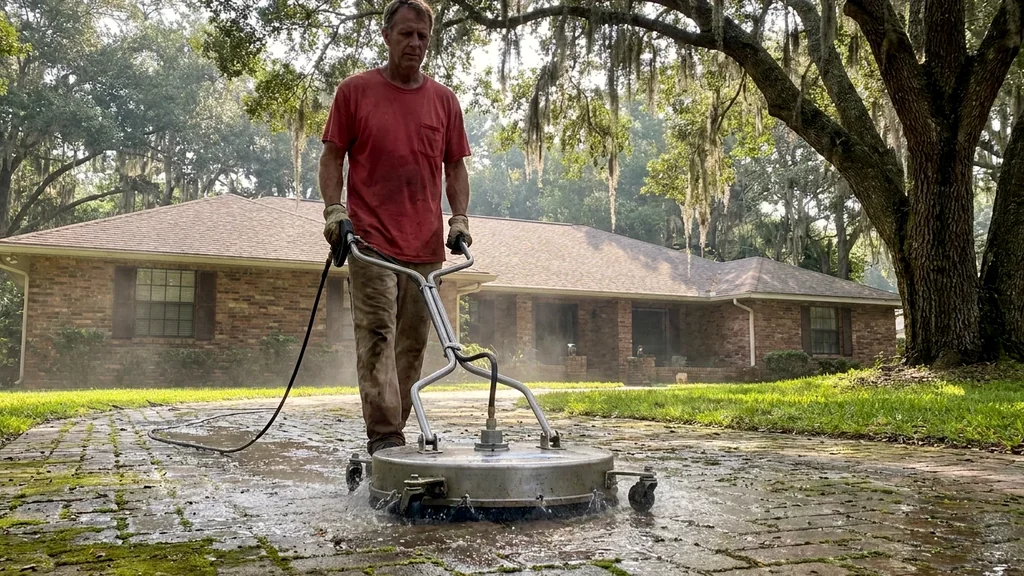
An algaecide goes on first to kill algae, mold and weeds at the root. A high-volume, low-pressure wash then lifts the growth without blasting the joints.
3. Refill the joints
Joint sand is swept in once the surface dries. It is then wet down so it compacts, a step Kennelly Paver and Restoration calls hydro-compacting.
4. Test for moisture, then coat
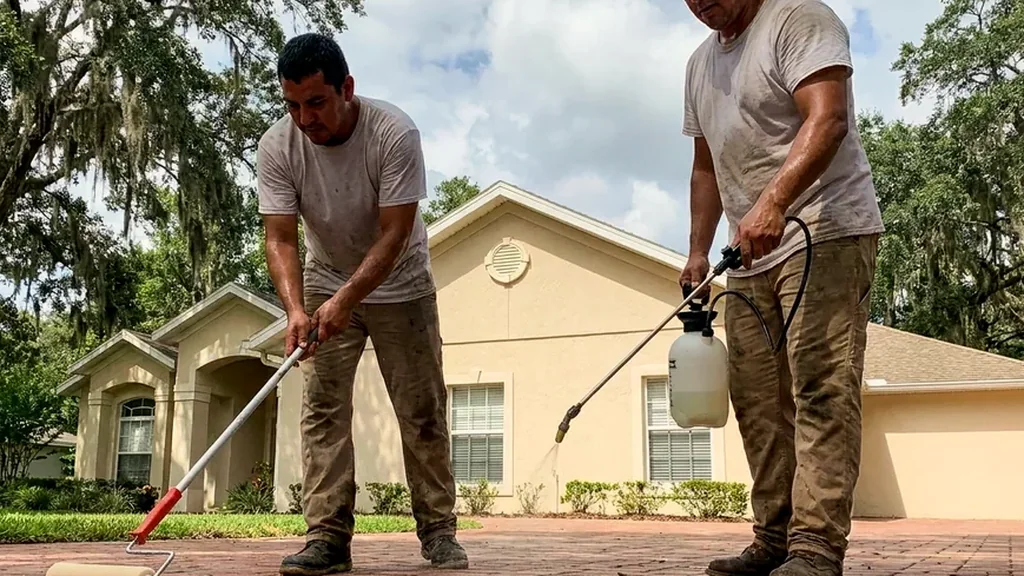
Western Interlock describes taping plastic sheeting over the pavers to see if condensation forms. If the plastic stays clear, a sprayer lays the sealer down and a dry roller takes up the puddles.
5. Walk the job with you
The contractor goes over the finished area and gives the stay-off times for the product used. Castle Clean and Seal lists 4 to 6 hours for feet, about a day for furniture and 48 hours for cars.
Frequently Asked Questions
How long does paver sealing last in Florida?
Expect two to five years. An Orlando paver company says two to four, Unilock says three to five, and A Cleaner Touch puts a wet look driveway at two to three years, a pool deck at two to four and a natural finish patio at three to five. Wet look finishes sit at the short end of those ranges.
What happens if pavers are not sealed?
They keep doing their job, but they wear faster. Bare pavers fade in the sun, take stains more easily and grow algae in humid air. Castle Clean and Seal adds that weeds and mold in an unsealed area spread into a sealed one beside it, so connected areas are better done together.
How much is paver sealing in Florida?
Across Central Florida the published rate for the full clean, sand and seal is $1.50 to $3.00 per square foot. Castle Clean and Seal lists driveways at $1.50 to $2.50 and pool decks at $1.75 to $3.00. A 600 square foot St. Cloud driveway comes to about $900 to $1,800 at the full range.
How much does it cost to resand and seal pavers?
The resanding is part of the same $1.50 to $3.00 per square foot, since joint sand goes in between the wash and the coat. A job that needs a failed coat stripped first runs higher, and Kennelly Paver and Restoration lists $3.50 to $5.00 per square foot for stripping and resealing.
Is it worth it to seal pavers?
Often, if your pavers are fading, losing sand or going green. Unilock calls sealing optional and says it is more about looks than upkeep, and it lists deeper color, stain resistance and tighter joints as the gains. The cost is a repeat job every few years, so weigh that against how the pavers look now.
Does St. Cloud's watering schedule change when a contractor can seal my pavers?
It can. Toho Water Authority sets watering days by house number, and Unilock asks for sprinklers to stay off for up to 48 hours after sealing. Give the contractor your house number so the job lands on days when the zones can be switched off.
How long does a paver sealing job take in St. Cloud?
A standard job finishes in a day, according to Kennelly Paver and Restoration, and stripping and resealing can take two to three. Water-based sealer needs three to four hours before anyone walks on it and 24 to 48 hours to cure, while solvent-based products can take up to 72.
Can the pavers around a St. Cloud pool be sealed?
Yes. Castle Clean and Seal lists pool decks at $1.75 to $3.00 per square foot and notes that chlorinated water and constant moisture are hard on them. Ask about a matte finish or a slip-resistant additive, because Unilock warns that high gloss can be slippery when wet.
Find out what your St. Cloud pavers need next
Give a contractor your street and the paved area on your mind, and a reply comes within 1 business day, often much sooner.
Free, no obligation